
Made possible by the Rivers
Institute and the History
Department of Hanover College.
The Great Comet of 1811
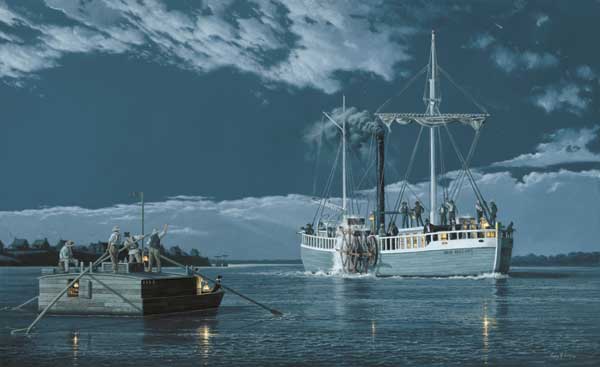
The Roosevelts arrive in Louisville with the Great Comet in
the sky above them (painting by Gary R. Lucy).
When the steamboat New Orleans
made her way down the Ohio and Mississippi Rivers from Pittsburgh to
New Orleans in 1811-1812, it marked a turning point in the
Transportation Revolution. After the New
Orleans showed that it could be done, steamboats
proliferated on the Ohio and the Mississippi and their
tributaries. Steamboat traffic helped create a national economy,
opening markets for farm goods and drawing people and commerce to
cities along the rivers.
The Great Comet of 1811, first observed in March and easily visible in
the night sky during September and October, made a dramatic backdrop
for the first weeks of the trip. More information on the Great Comet
of 1811 is available from astronomer Gary
W. Kronk.
June
5, 1811, Liberty Hall - first sighting of the comet
in Chillicothe, Ohio
June
8, 1811, Western Spy - first sighting of the comet in
Chillicothe, Ohio
Sept.
1811 a Lewisburg, Pennsylvania, schoolteacher describes the
comet in his journal
Sept.
8, 1811, American Daily Advertiser - the comet "much
admired for its beauty," with more precise observations to follow
Sept.
18, 1811 (in Two Lectures) - Harvard professor John
Farrar observes the Great Comet
Sept. 20, 1811, Farmer's Repository - a New York
observer describes the Great Comet
Sept.
25, 1811, Liberty Hall - Great Comet of 1811 visible
in the north
Sept.
28, 1811, Western Spy - astronomical observations of
the comet
Oct.
1811 (in Two Lectures) - a scientific observer in
Salem, Mass., describes the comet
Oct.
12, 1811, Western Spy - more astronomical observations
of the comet
Oct.
18, 1811, Weekly Raleigh Register - the "great
Architect" will not allow an orderly clockwork Creation to be
destroyed by a comet
Oct.
19, 1811, Western Spy - background on comets,
extracted from an astronomy textbook
Oct.
19, 1811, Western Spy - "ludicrous effects" of a 1712
comet
Oct. 28, 1811 -
The New Orleans Steaming Upstream by Moonlight, 1811
(painting by Gary R. Lucy) includes the Great Comet of 1811
Nov.
23, 1811, Louisiana Gazette - "Cosmopolites" dismisses
those who fear the comet will bring disaster -- "the great Architect"
would not destroy his creation
Dec.
6, 1811, Pittsburgh Gazette - humorous story about "an
honest Hibernian" in a London crowd gathered to view the comet
Dec.
10, 1811, (in Two Lectures) - Harvard professor John
Farrar describes the comet's path from September to December
Dec.
27, 1811, Pittsburgh Gazette - the phenomena of the
earthquake and the comet suggest that Nature can "no longer tolerate
the moral turpitude of man"
Jan.
25, 1812, Western Spy
- "whimsical account" of the comet
Jan.
29, 1812, Liberty Hall -
review of "remarkable events" in world history, relevant to the comet
Feb.
22, 1812, Western Spy - "various conjectures" about
the cause of the earthquake include "the comet's near approach to the
earth"
Feb.
26, 1812, Liberty Hall - reminder that the comet and
earthquake are not "signs" -- readers should be rational, not
superstitious
Mar.
7, 1812, Niles Weekly Register - lengthy summary of
scientific observations of the comet
Apr.
10, 1812, Pittsburgh Gazette - overview of momentous
events in 1811, including the comet
May
1812, Monthly Magazine and Literary Journal - a
"retrospect" of 1811, including the comet
1871, First Steamboat Voyage - Lydia Roosevelt's brother reports that the people of Louisville thought the comet had fallen in the river when the New Orleans arrived
More about the "Steamboat Adventure" of 1811-1812 --
Steamboat
Adventure homepage
Chronology
Spring 1811Summer 1811
Fall 1811
Winter 1811-1812
Spring 1812
Locations
PittsburghCincinnati
Louisville (Kentucky) and Madison (Indiana Territory)
New Madrid (now in Missouri)
Chickasaw Bluffs (now Memphis)
Natchez
New Orleans
Topics
Nicholas and Lydia RooseveltThe Transportation Revolution
The Great Comet of 1811
The New Madrid Earthquakes
Indian Relations
Questions or comments -- historians@hanover.edu