
[Page 65]
XENOPHANES of Kolophon, son of Dexias (Apollodoros says of Orthomenes), was the founder of the Eleatic School. After a careful review of the evidence, Zeller (Yorsokr. Phil. pp. 521-522) concludes that be was born about 580 B.C.; it is agreed by all writers that he lived to a great age. The stories of his travels and adventures are very numerous. He speaks of the war between the Ionic colonies and the Persians as beginning in his youth. According to Diogenes he sang the founding of Elea in 2,000 hexameter verses. The reference to him by Herakleitos (Fr. 16) indicates the general respect for his philosophy. He composed poetry of all varieties, and is said to have recited his own poems. His philosophic views were embodied in a poem which was early lost, and to which later ages gave the name 'περὶ φύσεως.'
[Page 66]
[Page 67]
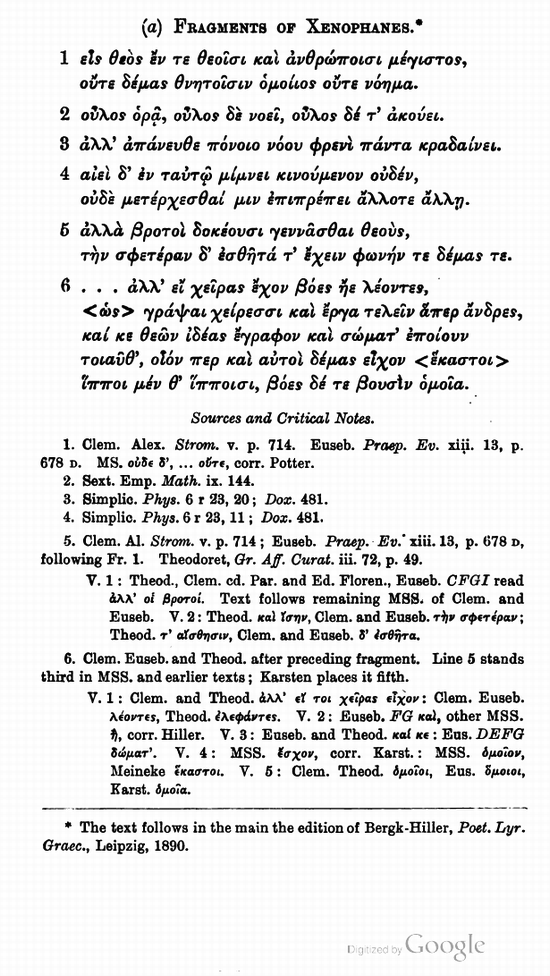
1. God is one, supreme among gods and men, and not like mortals in body or in mind.1
2. The whole [of god] sees, the whole perceives, the whole hears.2
3. But without effort he sets in motion all things by mind and thought.
4. It [i.e. being] always abides in the same place, not moved at all, nor is it fitting that it should move from one place to another.
5. But mortals suppose that the gods are born (as they themselves are), and that they wear man's clothing and have human voice and body.3
6. But if cattle or lions had hands, so as to paint with their hands and produce works of art as men do, they would paint their gods and give them bodies in form like their own—horses like horses, cattle like cattle.4
1. Zeller, Vorsokratische Philosophie, p. 530, n. 3.
2. Zeller, 526, n. 1. No author is given in the context; Karsten follows Fabricius in accrediting it to Xenophanes.
3. Zeller, 524, n. 2. Cf. Arist. Rhet. ii. 23; 1399 b 6.
4. Zeller, 525, n. 2. Diog Laer. iii. 16; Cic. de nat. Deor. i. 27.
[Page 68]
[Page 69]
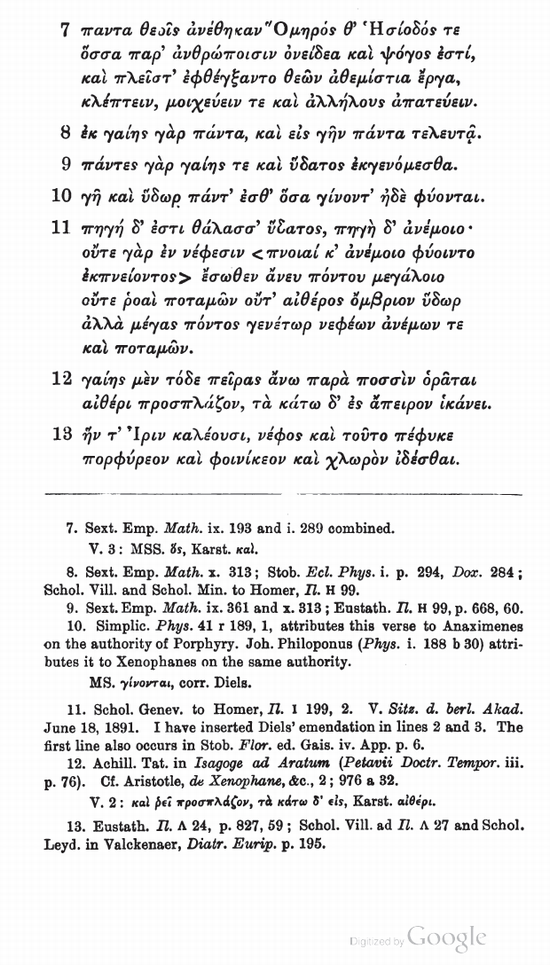
7. Homer and Hesiod attributed to the gods all things which are disreputable and worthy of blame when done by men; and they told of them many lawless deeds, stealing, adultery, and deception of each other.1
8. For all things come from earth, and all things end by becoming earth.2
9. For we are all sprung from earth and water.3
10. All things that come into being and grow are earth and water.
11. The sea is the source of water and the source of wind; for neither would blasts of wind arise in the clouds and blow out from within them, except for the great sea, nor would the streams of rivers nor the rain-water in the sky exist but for the sea; but the great sea is the begetter of clouds and winds and rivers.
12. This upper limit of earth at our feet is visible and †touches the air,† but below it reaches to infinity.4
13. She whom men call Iris (rainbow), this also is by nature cloud, violet and red and pale green to behold.
1. Zeller, 525, n. 3. Cf. Diog Laer. ix. 18; Sext. Emp. Pyrrh. i. 224.
2. Cf. Stob. Ecl. Phys. ii. 282, εκ πυρὸς γαρ τα παντα καὶ εὶς πυρ τα παντα τελευτα, which Karsten does not assign to Xenophanes.
3. Zeller, 541, n. 1. Cf. Sext. Emp. Pyrrh. ii. 30.
4. Cf. Arist. de Coelo ii. 13; 294 a 21.
[Page 70]
[Page 71]
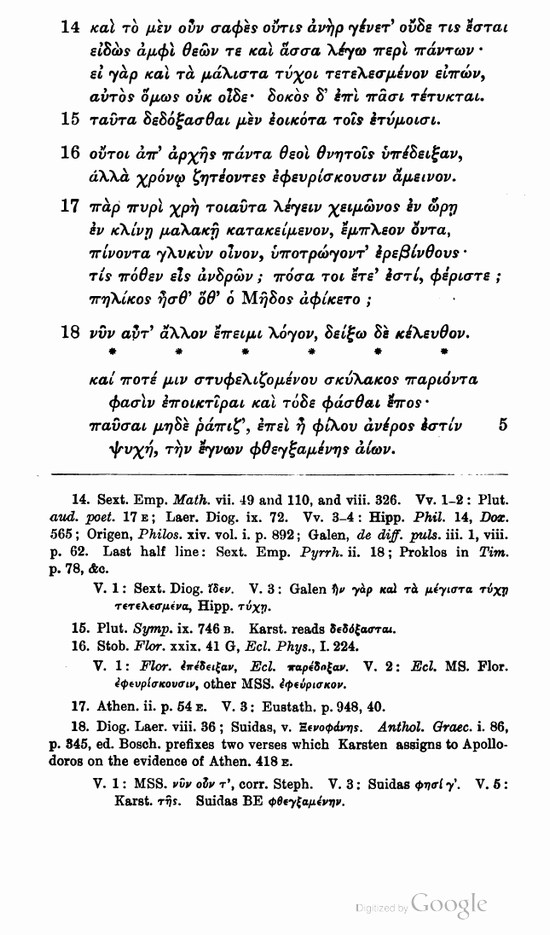
14. Accordingly there has not been a man, nor will there be, who knows distinctly what I say about the gods or in regard to all things, for even if one chances for the most part to say what is true, still he would not know; but every one thinks he knows.1
15. These things have seemed to me to resemble the truth.
16. In the beginning the gods did not at all reveal all things clearly to mortals, but by searching men in the course of time find them out better.
17. The following are fit topics for conversation for men reclining on a soft couch by the fire in the winter season, when after a meal they are drinking sweet wine and eating a little pulse: Who are you, and what is your family? What is your age, my friend? How old were you when the Medes invaded this land?
18. Now, however, I come to another topic, and I will show the way. . . . They say that once on a time when a hound was badly treated a passer-by pitied him and said, 'Stop beating him, for it is the soul of a dear friend; I recognised him on hearing his voice.'
1. Zeller, 549, n. 2. Burnett, 'All are free to guess.'
[Page 72]
[Page 73]
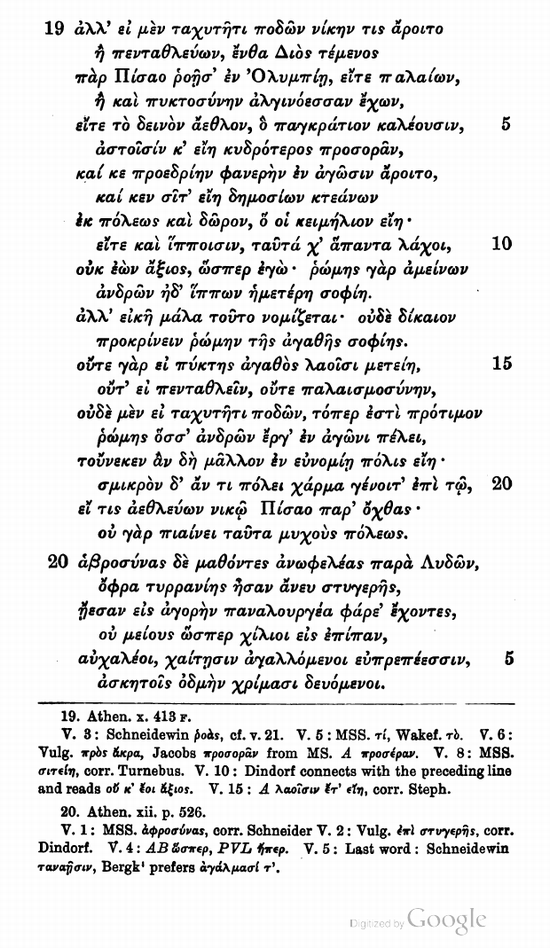
19. But if one wins a victory by swiftness of foot, or in the pentathlon, where the grove of Zeus lies by Pisas' stream at Olympia, or as a wrestler, or in painful boxing
| 5 | or in that severe contest called the pancration, he would be more glorious in the eyes of the citizens, he would win a front seat at assemblies, and would be entertained by the city at the public table, and he would receive a gift which would be a keepsake for him. If he won |
| 10 | by means of horses he would get all these things although he did not deserve them, as I deserve them, for our wisdom is better than the strength of men or of horses. This is indeed a very wrong custom, nor is it right to prefer strength to excellent wisdom. For if there |
| 15 | should be in the city a man good at boxing, or in the pentathlon, or in wrestling, or in swiftness of foot, which is honoured more than strength (among the contests men enter into at the games), the city would not on that account be any better governed. Small joy would it be |
| 20 | to any city in this case if a citizen conquers at the games on the banks of the Pisas, for this does not fill with wealth its secret chambers. |
20. Having learned profitless luxuries from the Lydians, while as yet they had no experience of hateful tyranny, they proceeded into the market-place, no less than a thousand in number all told, with purple garments completely covering them, boastful, proud of their comely locks, anointed with unguents of rich perfume.
[Page 74]
[Page 75]
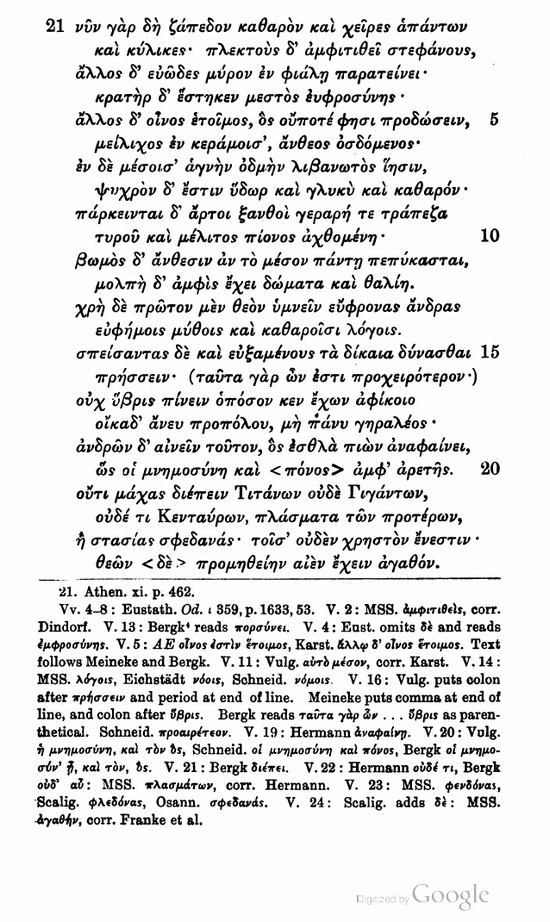
21. For now the floor is clean, the hands of all and the cups are clean; one puts on the woven garlands, another passes around the fragrant ointment in a vase; the mixing bowl stands full of good cheer, and more wine,
| 5 | mild and of delicate bouquet, is at hand in jars, which says it will never fail. In the midst frankincense sends forth its sacred fragrance, and there is water, cold, and sweet, and pure; the yellow loaves are near at hand, and the table of honour is loaded with cheese and rich |
| 10 | honey. The altar in the midst is thickly covered with flowers on every side; singing and mirth fill the house. Men making merry should first hymn the god with propitious stanzas and pure words; and when they have poured out libations and prayed for power to do the |
| 15 | right (since this lies nearest at hand), then it is no unfitting thing to drink as much as will not prevent your walking home without a slave, if you are not very old. And one ought to praise that man who, when he has drunk, unfolds noble things as his memory and his toil |
| 20 | for virtue suggest; but there is nothing praiseworthy in discussing battles of Titans or of Giants or Centaurs, fictions of former ages, nor in plotting violent revolutions. But it is good always to pay careful respect to the gods. |
[Page 76]
[Page 77]
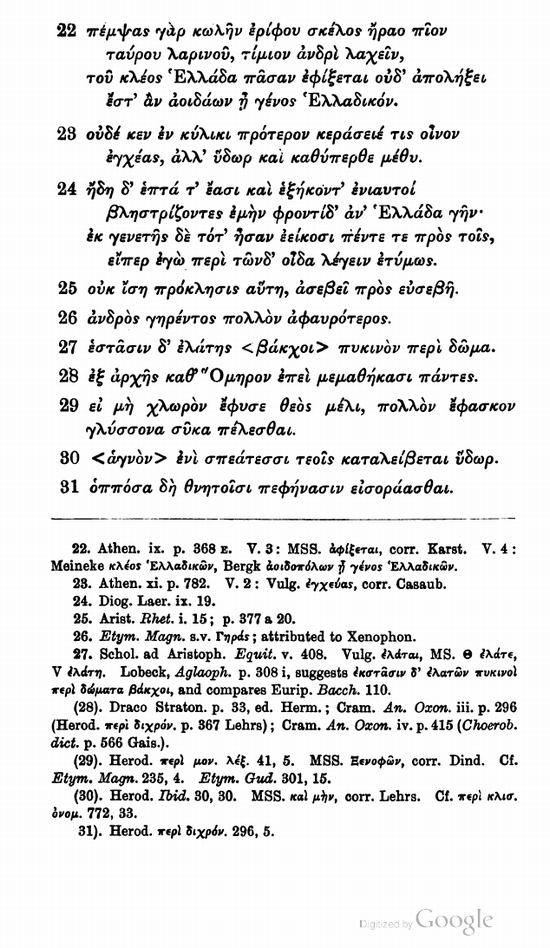
22. For sending the thigh-bone of a goat, thou didst receive the rich leg of a fatted bull, an honourable present to a man, the fame whereof shall come to all Greece, and shall not cease so long as there is a race of Greek bards.
23. Nor would any one first pour the wine into the cup to mix it, but water first and the wine above it.
24. Already now sixty-seven years my thoughts have been tossed restlessly up and down Greece, but then it was twenty and five years from my birth, if I know how to speak the truth about these things.1
25. Nor is this (an oath) an equal demand to make of an impious man as compared with a pious man.
26. Much more feeble than an aged man.
27. Bacchic wands of fir stand about the firmly built house.
28. From the beginning, according to Homer, since all have learned them.2
29. If the god had not made light-coloured honey, I should have said that a fig was far sweeter.
30. Holy water trickles down in thy grottoes.
31. As many things as they have made plain for mortals to see!
1. Bergk interprets φροντίδα by carmen.
2. Hiller, Deut. Litt. Zeitg., 1886, Coll. 474-475, suggests '(Men know the wanderings of Odysseus) from the beginning as Homer tells them, since all have learned them.'
[Page 78]
Arist. Rhet. ii. 23; 1399 b 6 (Karsten, Fr. 34). Xenophanes asserts that those who say the gods are born are as impious as those who say that they die; for in both cases it amounts to this, that the gods do not exist at all.
Ibid. 1400 b 5 (K. 35). When the inhabitants of Elea asked Xenophanes whether they should sacrifice to Leukothea and sing a dirge or not, he advised them not to sing a dirge if they thought her divine, and if they thought her human not to sacrifice to her.1
Plutarch, de vit. pud. p. 530 F (K. 36). When Lasos, son of Hermiones, called that man a coward who was unwilling to play at dice with him, Xenophanes answered that he was very cowardly and without daring in regard to dishonourable things.
Diog. Laer. ix. 20 (K. 37). When Empedokles said to him (Xenophanes) that the wise man was not to be found, he answered: Naturally, for it would take a wise man to recognise a wise man.
Plut. de comm. not. p. 1084 E (K. 38). Xenophanes, when some one told him that he had seen eels living in hot water, said: Then we will boil them in cold water.
Diog. Laer. ix. 19 (K. 39). 'Have intercourse with tyrants either as little as possible, or as agreeably as possible.'
Clem. Al. Strom. vii. p. 841. And Greeks suppose the gods to be like men in their passions as well as in their forms; and accordingly they represent them, each race in forms like their own, in the words of Xenophanes: Ethiopians make their gods black and snub-nosed, Thracians red-haired and with blue eyes; so also they conceive the spirits of the gods to be like themselves.2
1. Cf. Plutarch, Amat. p. 732 D; Is. et Os. p. 379 B.
2. Cf. Theod. Graec. Aff. Cur. iii. p. 49.
[Page 79]
A. Gellius, Noct. Att. iii. 11 (K. 31). Some writers have stated that Homer antedated Hesiod, and among these were Philochoros and Xenophanes of Kolophon; others assert that he was later than Hesiod.
Plato, Soph. 242 D. And the Eleatic group of thinkers among us, beginning with Xenophanes and even earlier, set forth in tales how what men call all things is really one.
De Coelo, ii. 13; 294 a 21. On this account some assert that there is no limit to the earth underneath us, saying that it is rooted in infinity, as, for instance, Xenophanes of Kolophon; in order that they may not have the trouble of seeking the cause.1
De mirac. oscult. 38; 833 a 16. The fire at Lipara, Xenophanes says, ceased once for sixteen years, and came back in the seventeenth. And he says that the lava-stream from Aetna is neither of the nature of fire, nor is it continuous, but it appears at intervals of many years.
Metaph i. 5; 986 b 10. There are some who have expressed the opinion about the All that it is one in its essential nature, but they have not expressed this opinion after the same manner nor in an orderly or natural way. 986 b 23. Xenophanes first taught the unity of these things (Parmenides is said to have been his pupil), but he did not make anything clear, nor did he seem to get at the nature of either of these things, but looking up into the broad heavens he said: The unity is god.
1. Two passages from the Rhet. ii 23 are translated above, p. 78. Extracts from the book are ordinarily called De Xenophane, Zenone, Gorgia, and ascribed to Aristotle, are in part translated below, p. 80, n. 2 ff., in connection with the fragment of Theophrastos which covers exactly the same ground.
[Page 80]
These, as we have said, are to be dismissed from the present investigation, two of them entirely as being rather more crude, Xenophanes and Melissos; but Parmenides seems to speak in some places with greater care.1
Theophrastos, Fr. 5; Simpl. Phys. 5v: 22, 36; Dox. 480. Theophrastos says that Xenophanes of Kolophon, teacher of Parmenides, asserted that the first principle is one, and that being is one and all-embracing, and is neither limited nor infinite, neither moving nor at rest. Theophrastos admits, however, that the record of his opinion is derived from some other source than the investigation of nature. This all-embracing unity Xenophanes called god; he shows that god is one because god is the most powerful of all things; for, he says, if there be a multiplicity of things, it is necessary that power should exist in them all alike; but the most powerful and most excellent of all things is god.2 And he shows that god must have been without beginning, since whatever comes into being must come either from what is like it or from what is unlike it; but, he says, it is no more natural that like should give birth to like, than that like should be born from like; but if it had sprung from what is unlike it, then being would have
1. V. Zeller, Vorsokr. Phil. i. 513, n. 1; Diels' Dox. p. 110; Teichmüller, Studien, p. 607.
2. Cf. Arist. Xen. Zen. Gorg. 977 a 23. It is natural that god should be one; for if there were two or more, he would not be the most powerful and most excellent of all. . . . If, then, there were several beings, some stronger, some weaker, they would not be gods; for it is not the nature of god to be ruled. Nor would they have the nature of god if they were equal, for god ought to be the most powerful; but that which is equal is neither better nor worse than its equal.
[Page 81]
sprung from not-being.1 So he showed that god is without beginning and eternal. Nor is it either infinite or subject to limits; for not-being is infinite, as having neither beginning nor middle nor end; moreover limits arise through the relation of a multiplicity of things to each other.2 Similarly he, denies to it both motion and rest; for not-being is immovable, since neither could anything else come into it nor could it itself come into anything else; motion, on the one hand, arises among the several parts of the one, for one thing changes its position with reference to another, so that when he says that it abides in the same state and is not moved (Frag. 4.) 'And it always abides in the same place, not moved at all, nor is it fitting that it should move from one place to another,' he does not mean that it abides in a rest that is the antithesis of motion, but rather in a stillness that is out of the sphere of both motion and rest. Nikolaos of Damascus in his book On the Gods mentions him as saying that the first principle of things is infinite and immovable.3 According to Alexander he regards this principle as limited and spherical. But that Xenophanes shows it to be neither limited nor infinite is clear from the very words
1. Cf. Arist. X. Z. G. 977 a 19. He adds: For even if the stronger were to come from the weaker, the greater from the less, or the better from the worse, or on the other hand the worse from the better, still being could not come from not-being, since this is impossible. Accordingly god is eternal.
2. Cf. Arist. X. Z. G. 977 b 6. The second part reads: But if there were several parts, these would limit each other. The one is not like not-being nor like a multiplicity of parts, since the one has nothing by which it may be limited.
3. Cf. Arist. X. Z. G. 977 b 13. He adds: Nothing, however, can be moved into not-being, for not-being does not exist anywhere. But if there is change of place among several parts, there would be parts of the one. Therefore the two or more parts of the one may be moved; but to remain immovable and fixed is a characteristic of not-being. The one is neither movable nor is it fixed; for it is neither like not-being, nor like a multiplicity of being.
[Page 82]
quoted,—Alexander says that he regarded it as limited and spherical because it is homogeneous throughout; and he holds that it perceives all things, saying (Frag. 3) 'But without effort he sets in motion all things by mind and thought.'1
Theophrast. Fr. 5a; Galen, in Hipp. d. n. h. xv. 35 K.; Dox. 481. Several of the commentators have made false statements about Xenophanes, as for instance Sabinos, who uses almost these very words: 'I say that man is not air, as Anaximenes taught, nor water, as Thales taught, nor earth, as Xenophanes says in some book;' but no such opinion is found to be expressed by Xenophanes anywhere. And it is clear from Sabinos's own words that he made a false statement intentionally and did not fall into error through ignorance. Else he would certainly have mentioned by name the book in which Xenophanes expressed this opinion. On the contrary he wrote 'as Xenophanes says in some book.' Theophrastos would have recorded this opinion of Xenophanes in his abridgment of the opinions of the physicists, if it were really true. And if you are interested in the investigation of these things, you can read the books of Theophrastos in which he made this abridgment of the opinions of the physicists.
Hipp. Philos. i. 14; Dox. 565. Xenophanes of Kolophon, son of Orthomenes, lived to the time of Cyrus. He was the first to say that all things are incomprehensible, in the following verses: (Frag. 14) 'For even if one chances for the most part to say what is true, still he would not know; but every one thinks he
1. Cf. Arist. X. Z. G. 977. Since god is a unity, he is homogeneous in all his parts, and sees and hears and has other sensations in all his parts. Except for this some parts of god might rule and be ruled by one another, a thing which is impossible. Being homogeneous throughout he is a sphere in form; for it could not be spheroidal in places but rather throughout.
[Page 83]
knows.'1 And he says that nothing comes into being, nor is anything destroyed, nor moved; and that the universe is one and is not subject to change. And he says that god is eternal and one, homogeneous throughout, limited, spherical, with power of sense-perception in all parts. The sun is formed each day from small fiery particles which are gathered together; the earth is infinite, and is not surrounded by air or by sky; an infinite number of suns and moons exist, and all things come from earth. The sea, he said, is salt because so many things flow together and become mixed in it; but Metrodoros assigns as the reason for its saltness that it has filtered through the earth.2 And Xenophanes believes that once the earth was mingled with the sea, but in the course of time it became freed from moisture; and his proofs are such as these: that shells are found in the midst of the land and among the mountains, that in the quarries of Syracuse the imprints of a fish and of seals had been found, and in Paros the imprint of an anchovy at some depth in the stone, and in Melite shallow impressions of all sorts of sea products. He says that these imprints were made when everything long ago was covered with mud, and then the imprint dried in the mud. Farther he says that all men will be destroyed when the earth sinks into the sea and becomes mud, and that the race will begin anew from the beginning; and this transformation takes place for all worlds.
Plut. Strom. 4; Dox. 580. Xenophanes of Kolophon, going his own way and differing from all those that had gone before, did not admit either genesis or destruction, but says that the all is always the same. For if it came into being, it could not have existed before this; and not-being could not come into existence
1. Epiph. adv. Haer. iii. 9; Dox. 590.
2. Zeller, Vorsokr. Phil. 543, n. 1.
[Page 84]
nor could it accomplish anything, nor could anything come from not-being. And he declares that sensations are deceptive, and together with them he does away with the authority of reason itself. And he declares that the earth is constantly sinking little by little into the sea. He says that the sun is composed of numerous fiery particles massed together. And with regard to the gods he declares that there is no rule of one god over another, for it is impious that any of the gods should be ruled; and none of the gods have need of anything at all, for a god hears and sees in all his parts and not in some particular organs.1 He declares that the earth is infinite and is not surrounded on every side by air; and all things arise from earth; and he says that the sun and the stars arise from clouds.
Galen, Hist. Phil. 3; Dox. 601. Xenophanes of Kolophon is said to be the chief of this school, which is ordinarily considered aporetic (skeptical) rather than dogmatic. 7; Dox. 604. To the class holding eclectic views belongs Xenophanes, who has his doubts as to all things, except that he holds this one dogma: that all things are one, and that this is god, who is limited, endowed with reason, and immovable.
Aet. Plac. i. 3; Dox. 284. Xenophanes held that the first principle of all things is earth, for he wrote in his book on nature: 'All things come from earth, and all things end by becoming earth.'2
Aet. ii. 4; Dox. 332. Xenophanes et al.: The world is without beginning, eternal, imperishable. 13; 343. The stars are formed of burning cloud; these are extinguished each day, but they are kindled again at night, like coals; for their risings and settings are
1. Zeller, Vorsokr. Phil. p. 526, n. 4; Arch f. d. Gesch. d. Phil. ii. 1889, pp. 1-5.
2. Epiph. adv. Haer. iii. 9; Dox. 590.
[Page 85]
really kindlings and extinguishings. 18; 347. The objects which appear to those on vessels like stars, and which some call Dioscuri, are little clouds which have become luminous by a certain kind of motion. 20; 348. The sun is composed of fiery particles collected from the moist exhalation and massed together, or of burning clouds. 24; 354. Eclipses occur by extinction of the sun; and the sun is born anew at its risings. Xenophanes recorded an eclipse of the sun for a whole month, and another eclipse so complete that the day seemed as night. 24; 355. Xenophanes held that there are many suns and moons according to the different regions and sections and zones of the earth; and that at some fitting time the disk of the sun comes into a region of the earth not inhabited by us, and so it suffers eclipse as though it had gone into a hole; he adds that the sun goes on for an infinite distance, but it seems to turn around by reason of the great distance. 25; 356. The moon is a compressed cloud. 28; 358. It shines by its own light. 29; 360. The moon disappears each month because it is extinguished. 30; 362. The sun serves a purpose in the generation of the world and of the animals on it, as well as in sustaining them, and it drags the moon after it.
Aet. iii. 2; 367. Comets are groups or motions of burning clouds. 3; 368. Lightnings take place when clouds shine in motion. 4; 371. The phenomena of the heavens come from the warmth of the sun as the principal cause. For when the moisture is drawn up from the sea, the sweet water separated by reason of its lightness becomes mist and passes into clouds, and falls as rain when compressed, and the winds scatter it; for he writes expressly (Frag. 11): 'The sea is the source of water.'
Aet. iv. 9; 396. Sensations are deceptive.
Aet. v. 1; 415. Xenophanes and Epikouros abolished the prophetic art.
Simp. Phys. = Simplicii in Aristotelis physicarum libros qua ores edidit H. Diels, Berlin 1882.
Simp. Cael. = Simplicius, Commentary on Aristotle's De caelo.
Dox. = Diels, Doxographi Graeci, Berlin 1879.